African Telescope Independent Journalism. African Perspectives
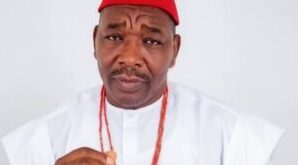
Professor Nnamdi Aduba, a Nigerian Professor of Public Law, human rights advocate, and member of the Yiaga Africa Board of Trustees, speaks with OLUMIDE OLUSEGUN on U.S. President Donald Trump’s immigration policies, Nigeria’s bilateral relations, and the country’s path toward the 2027 general elections.
You recently expressed opposition towards the policies of President Donald Trump. What is your position on his style of governance?
When you look at his style, it seems ad-hoc. He just wakes up in the morning with a brainwave, tweets it, and that’s how it goes. One minute he makes up his mind; the next minute he changes it. There is no certainty. And if you imagine, how can a leader of the First World deal with people like a bully? There is no room for diplomacy. It’s just like a headmaster dishing out instructions, changing his mind at will, not regarding old relationships, and turning everything upside down. All the diplomatic lines that define relationships between countries and cultures are thrown overboard. You reach a bilateral agreement with someone, and suddenly you unilaterally revoke it. You impose this tariff or that tariff. As far as Trump is concerned, it is either his way or no way at all. So where does the role of negotiation come in? Is that how a modern world should be ruled—by uncertainty, by the whims and purposes of one individual? Ask him a question, he replies rudely and may even abuse you for asking. I said it before—Donald Trump doesn’t have respect for any institution. All over the world, universities are respected as institutions where freedom is allowed. Why should a President of the United States start interfering in the affairs of universities? So, all the ideals that Third World countries have been copying from America, Trump has turned upside down. He is behaving like a Third World leader—not a leader of the developed world that has enormous soft power and goodwill. America was an example of an independent society and respect for the rule of law, but here we are with a president behaving like this. It is something really very disgusting.
What are some of the policies he has initiated that you feel were wrong, and what do you make of them?
Look at immigration. I nearly suffered one recently. I got an American visa in June for five years—where is the money even to go to America? And suddenly he wakes up and says he is limiting it to three months. This is not supposed to happen. You struggle to get a visa to America, and suddenly they say if you don’t use it after three months, you have to apply again. Is that fair? So you don’t have regard for people’s feelings and plans? What about the aspect of just waking up and saying, “These countries, you will not allow them to come into America”? What did they do? I teach human rights. See what he did to migrants. Are they not human beings? There are laws that protect refugees. If you are being persecuted in your country, other countries have obligations to assist you. How was America founded? Was it not a place where those who were persecuted could go? They welcomed people. But what is happening now? What are you teaching people? Have you seen people being deported? Put in shackles? Did you see how they were treated? The impression it gives is that America is simply a racist country. They don’t consider the public image of others. It doesn’t bother them. Have you ever seen how Black Americans are treated? The privileges seem to favor whites—as if Black and brown Americans have no rights. There was a video that went viral of a Nigerian. How the police caught, handcuffed, humiliated, and mistreated him. At the end of the day, no apology. Just intimidation. Is that how people should be treated? I am a lawyer by profession. When you talk about judges, you talk to them with a lot of respect. Do you see how he talks about judges in America? The ones who give him favorable judgments, he praises; the ones who don’t, he criticizes. How can a president be involved in such petty things? Every small insult, he responds to it.
Trump stopped the funding and provision of aid to WHO and Africa by extension. Although some commentators, including WTO DG Ngozi Okonjo-Iweala, have said Africa can no longer depend on aid. What is your take on the impact of this policy on Africa?
Why wouldn’t you want to give them aid? This is one of the richest countries in the world. If they cannot bend backwards to assist poor countries, then what is charity all about? Must everything be transactional? Must it be “America First”? America is using its strength against weaker nations. Imagine a project that is supposed to run for five years—barely three years in, and you cancel it. There’s something called the sanctity of contract, which means when you enter into an agreement, each party is expected to keep their side. In the twinkle of an eye, he single-handedly ends everything. Some have actually taken him to court—but for Third World countries, where can they go? Even if Okonjo-Iweala said the time has come to stop the aid—yes, the time has come. But shouldn’t there at least be a notice? He has wrecked lives because some of these programmes were actually meant to save lives. Do you know that sometimes, of all the aid they say they’re bringing to Nigeria, less than 10% actually gets here? You may be given a grant, but by the time the money gets to you, there’s almost nothing left. Most of the consultants for that grant are based in Europe. By the time you remove the money for consultants and other costs, what’s left is very small. So, when people say they’re helping Third World countries, sometimes the help is minimal. The conditions for executing those projects often leave you at a disadvantage.
How would you describe the bilateral relationship under the current administration of President Bola Tinubu?
Starting with the Tinubu administration, it is finding it hard to appoint ambassadors. How can you not have ambassadors in some of these countries? Sometimes we just play with things we shouldn’t play with, when we should be setting examples for other African countries. It shows a lack of seriousness. What does it take to appoint? If there are no resources, you can merge. How many years are remaining now? Less than two years. Despite the credits Tinubu gets for being a strategist, does what he is doing now show anything close to that of a great planner? What he is doing shows opportunism—talk and talk, but you cannot walk the talk. There is no seriousness in asserting our independence. People complained that Buhari was travelling and spending money on medical treatment, and now Tinubu comes in and proceeds to France. So when are we going to release ourselves from these imperialist countries? When you go abroad, some of the best medical doctors are Nigerians. So why can’t you create an environment with adequate facilities to accommodate them here? By doing so, you would not need to spend so much travelling abroad for treatment.
This is despite the several funds Nigerians have been told by successive governments that have been invested in the health sector, including the N21 billion Presidential Wing of the State House Medical Centre, yet nothing has changed and they keep travelling.
Exactly. Every one of them—including the governors. Even the former governor of Kogi who is on trial—didn’t you hear that he was requesting to travel abroad for treatment? They are just making themselves look like jokers. And at the same time, they are shouting that young doctors who are migrating shouldn’t migrate. So what do you want them to do? You are not willing to give them facilities to work, you are not willing to pay them well, but you are willing to impose restrictions on their freedom of movement.
The Minister for Foreign Affairs, Yusuf Tuggar, attributed the delay in appointing ambassadors to financial and economic challenges. What is your take on that?
My take is, how many years are remaining for them? Does it mean that the APC never had a foreign policy plan? In my view, this is supposed to be a continuation of the former government. Government is a continuum. So doesn’t this show a lack of seriousness on their part? How long does it take? If you are going to merge countries, merge them. If you want to close some embassies, close them. Do that quickly now. You are talking about diversification. You have been travelling—some of these trips are unnecessary. That is why you should have an ambassador there. You appoint an ambassador so that you can limit travel and still show your presence in those countries. With the technology in the modern world, when you improve, the whole world will know. You don’t need to go there. I am really uncomfortable with the response of the minister. It shows a lack of seriousness.
The United States President recently hosted African leaders, but Nigeria was not there. What is your take on it?
It is the way they consider us. That is why people say the man is a confused person—I’m sorry to say this. You are planning to build the largest U.S. embassy in the whole world in Nigeria, and you want to host African leaders, and you didn’t call Nigeria? Does that make sense to you? The trade between Nigeria and America—what is it? The highest number of migrants with postgraduate qualifications in America are Nigerians. And you don’t think you need Nigeria at the table when you’re talking about Africa? That shows the shallowness of their thinking. Some of the other African countries are not even up to the size of Lagos State. As far as Trump is concerned, he doesn’t even understand the modern world. He lacks the capacity to appreciate the interconnectivity of the modern world. Where you have markets, that’s where you go. We need their money, and they need our oil. I think it is shallowness on the part of America not to have invited Nigeria.
What do you think the Nigerian government should do with this development?
There is no question of what to do. It is that we are not serious. We talk about reciprocity, but when you see how people go and queue like flies around the U.S. Embassy—now going to the U.S. is like going to heaven—so they just treat us anyhow. Sometimes you wonder, do they even appreciate that people are coming to their embassies? There are no seats outside for people to sit down. They are in the sun, standing, and it doesn’t bother them.
But who is to be blamed? Is it the U.S. government or our leaders?
Yes, it is true, but two wrongs do not make a right. Somebody should lead by example. They say if somebody is treating you unfairly, treat the person fairly. You can’t be talking about civilization, westernization, principles of fairness, dignity of the human being, democracy, and respect for human dignity, while the people who are coming to the country are allowed to stand under the scorching sun. What will it cost you to provide seats and shade for them? Now, we see that everything in this modern world is about perception. So, when you see a country condescendingly looking at another country and treating its people like trash, it is not the right thing to do. Yes, our leaders are not doing well, but somebody must lead by example. And the U.S., as a country that several others look up to, should be that example in this case.
The political atmosphere in Nigeria has started to become tense ahead of 2027 with defections and the emergence of coalitions. What is your take on it?
I have never believed that there is a difference between APC (All Progressives Congress) and PDP (Peoples Democratic Party). I had that argument with some of my students, but they later agreed that I was right because almost all the people in PDP left for the APC. Somebody became a governor under PDP, ruled for eight years, left PDP, joined APC, and went to the Senate—and there is no apology, and he fits in. Did you see how (Godswill) Akpabio, who was formerly the Minority Leader of the PDP, suddenly defected to the APC and he fits in? What does this show you? The PDP governor suddenly said he is no longer PDP but APC—and no apologies. What does it show you? So, when you talk about our politicians, I will tell you: there are no principles, there are no ideologies. All is personal interest, accumulation of wealth, and poorly played politics. Without principles, with unethical practices, they have reduced politics to transactional politics. So, when you look at what is happening—garbage in, garbage out. So what are you expecting from that? There are no longer quality debates in this Senate. Look at what is happening in Lagos. Local government elections—one party clears everything, leaving one councillor to the opposition. And the same thing played out in almost all the states, if not all, across Nigeria. What does it tell you?