 African Telescope Independent Journalism. African Perspectives
By Ogar Emmanuel
Nigeria has emerged as a global reference point for steady and credible reform leadership, the World Bank’s Managing Director of Operations, Anna Bjerde, said on Tuesday.
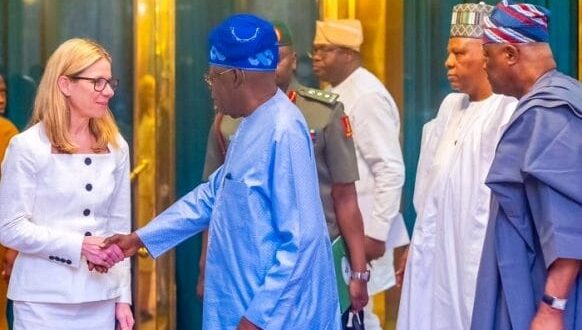
Bjerde made the remark during a meeting with President Bola Ahmed Tinubu and Vice President Kashim Shettima at the State House, Abuja, praising the administration’s resolve to sustain difficult but necessary economic reforms.
“Nigeria is now frequently cited around the world as an example of consistent and credible reform leadership,” she said. “The government has stayed the course despite the challenges, and the results are beginning to show.”
She noted that the clarity, consistency and early gains from the reforms have strengthened confidence among investors, policymakers and the private sector.
The World Bank chief said the institution’s forthcoming Country Partnership Framework would be firmly aligned with Nigeria’s development priorities, including the ambition to achieve a $1 trillion economy and seven per cent annual growth.
President Tinubu, who was joined at the meeting by the Minister of Finance and Coordinating Minister of the Economy, Wale Edun, and Deputy Chief of Staff to the President, Ibrahim Hassan Hadejia, reaffirmed his administration’s commitment to economic reforms.
“Though the process has been challenging, there will be no turning back,” the President said.
Tinubu acknowledged that the removal of fuel subsidy and the unification of exchange rates initially fuelled inflation, but said the pressures have eased significantly.
“Inflation is coming down, the naira has stabilised, and investor confidence is improving,” he said, adding that the reforms are anchored on transparency, accountability and policy stability.
The President highlighted agriculture as a key pillar of his economic agenda, citing investments in zonal mechanisation centres, improved seeds, fertiliser availability and support from the petrochemical industry.
“Nigeria is the heart of the continent. With our young population and vast arable land, we must strengthen the economy through agriculture,” Tinubu said.
“We are making mechanisation easier for farmers and helping them move from subsistence farming to strong cooperatives.”
Tinubu urged the World Bank to deepen its partnership with Nigeria by accelerating financing, reducing bureaucracy, sharing global development models and building local capacity to fast-track inclusive growth.
Bjerde, in response, stressed the importance of expanding access to finance for small, medium and mid-sized enterprises, describing them as major drivers of jobs and productivity.
She also commended Nigeria’s focus on early childhood development, warning that rising stunting levels remain a challenge even in middle-income countries.
“Early childhood development is a strong entry point for long-term productivity, and we are fully supportive of Nigeria’s approach,” she said.
Bjerde reaffirmed the World Bank Group’s commitment to Nigeria through its institutions — IDA, IBRD and IFC — assuring continued support for the country’s reform agenda through a mix of public and private sector intervention.










