 African Telescope Independent Journalism. African Perspectives
By African Telescope |
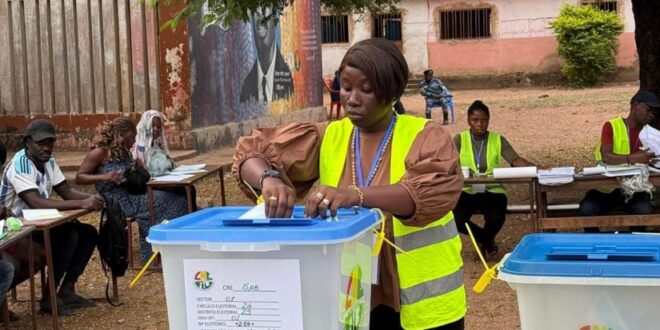
Guinea-Bissau has begun counting votes cast in Sunday’s presidential and legislative elections, a tense contest in which President Umaro Sissoco Embaló is seeking a second term in a country long troubled by coups and political instability.
The vote, described by analysts as one of the most contentious in recent years, comes at a sensitive moment for West Africa, where disputed elections and military takeovers have strained democratic systems.
Early assessments suggest a close race between Embaló and Fernando Dias da Costa, a 47-year-old political newcomer backed by former prime minister Domingos Simões Pereira. Pereira, who finished second in the 2019 election, was barred from the ballot after authorities said his party failed to submit documents early enough.
To win outright, a candidate must secure more than 50 percent of the vote; otherwise, a runoff will be held.
Embaló, 53, voted in Gabu, about 200 kilometres from the capital, Bissau. He urged the electorate to participate peacefully, saying, “I am the one who will serve a second term, and I hope that the electoral process will take place calmly and peacefully.”
Dias accused the government of attempting to intimidate his supporters, warning after casting his vote that his party would not tolerate arrests or harassment. He campaigned on promises of stability, freedoms and security, repeatedly criticising what he called “systematic” human rights violations under Embaló’s administration.
The incumbent, a former army general who entered office in 2021, is backed by a coalition of more than 20 political groups and is facing 11 other challengers.
Nearly half of Guinea-Bissau’s 2.2 million citizens are registered to vote. The election, however, has been overshadowed by the exclusion of the main opposition party, the African Party for the Independence of Guinea and Cape Verde, which won the last legislative elections but was barred from contesting on Sunday.
Political analyst Augusto Nansambe said the country’s democracy had deteriorated into “a model defined by a single person.”
The nation, one of the poorest in the world, continues to grapple with widespread poverty and its position as a key trafficking route for drugs smuggled between Latin America and Europe. It has experienced repeated coups and attempted coups since gaining independence from Portugal more than five decades ago.
The election is taking place amid uncertainty about Embaló’s mandate. Although he won the 2019 vote and was sworn in in early 2020, his victory was not validated by the Supreme Court until September of that year. Opposition groups insist his term expired in February, but the court ruled that it should run until September, even though the current vote was delayed to November.
The parliamentary contest is also unusual, as the opposition-controlled legislature has not sat since December 2023, when Embaló dissolved it following what he described as an attempted coup.
The campaign period featured accusations of hate speech, corruption and politically motivated killings, prompting warnings from observers that the country could face further instability.
Embaló focused his campaign on infrastructure projects, including roads and the modernisation of the main airport. Dias urged voters to “vote for change, for national unity, for reconciliation, for peace, and for an end to the authoritarian regime.”
In Bissau, voter Marinho Insoldé said he was hopeful the result would ease hardship. “I hope that these elections will bring peace and tranquility so that there is no more hunger,” he said.
Results are expected in the coming days.










