 African Telescope Independent Journalism. African Perspectives
By African Telescope |
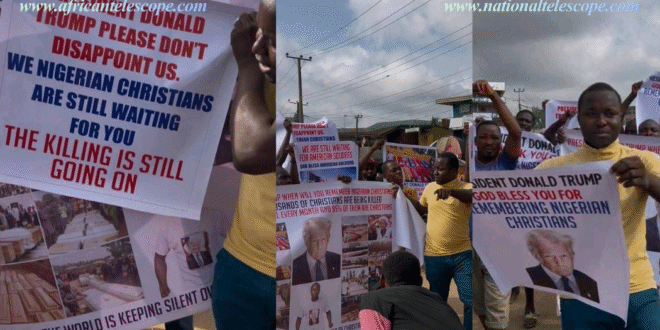
A wave of concern among Nigerian Christians took a new turn on Friday as worshippers in Enugu staged a peaceful protest calling on former United States President Donald Trump to intervene in the country’s worsening security situation.
Led by Evangelist Ebube Joseph, the protesters gathered at strategic locations carrying placards bearing Trump’s image and messages appealing for international rescue.
Their call reflected a growing fear within Christian communities in parts of the country, especially the North and Middle Belt, where attacks by armed groups have persisted for years.
Some of the placards read: “President Donald Trump, God bless you for remembering Nigerian Christians,” “We are still waiting for American soldiers,” and “Trump, when will you remember Nigerian Christians? Thousands of Christians are being killed.”
Addressing the protesters, Evangelist Joseph said Christians were still under attack and urged Trump to “not disappoint us.” He insisted that killings were ongoing and argued that only international intervention could compel Nigerian authorities to act decisively.
The demonstration comes amid heightened tension between Nigeria and the United States following Trump’s October 31 decision to designate Nigeria a Country of Particular Concern over what he described as Christian genocide.
Trump had warned that unless the Nigerian government halted the killings, the United States could deploy troops to “wipe out the jihadists.”
Trump’s comments sparked sharp reactions within Nigeria. While the Federal Government dismissed the genocide claim, key Christian bodies such as the Pentecostal Fellowship of Nigeria and the Christian Association of Nigeria welcomed the statement as long overdue.
The Pentecostal Fellowship of Nigeria has consistently maintained that Christians in several parts of the country face targeted attacks. Speaking on Thursday, PFN President Bishop Wale Oke insisted that “the evidence is all over the place.”
“There is nothing anybody can say that can whitewash it. It is evil, it is mass murder and it is genocide. The time to stop it is now,” he said.
Oke accused armed groups including bandits, Boko Haram, ISWAP and violent herdsmen of using religion as a cover to attack Christian populations. He also alleged that over 500 Christians were recently killed in Dogonaya, Plateau State.
“We are crying out to our international friends, beginning with America and Donald Trump. Whatever you can do to help our government put an end to it, come quickly and get it done,” Oke said.
He urged the government to rebuild trust, warning that many Christians believe the country’s security architecture has been compromised by individuals sympathetic to extremist ideologies.
The Christian Association of Nigeria added its voice on Friday, accusing the Presidency of twisting its position on the killings.
In a statement signed by its President, Archbishop Daniel Okoh, CAN said it never used the phrase “so-called Christian genocide” as suggested in a press release reportedly issued by presidential aide Daniel Bwala after a visit to CAN headquarters in Abuja.
“That portrayal is completely false and grossly unfair,” Archbishop Okoh said.
According to CAN, its leaders made it clear during the meeting that Christian communities across the North and Middle Belt have suffered repeated organised attacks for many years.
“These are not isolated crimes but a continuing pattern of violence that has persisted without justice,” CAN said.
During the meeting, Bishop Mike Akpami presented data showing consistent attacks against Christian communities across several regions of Africa, including Nigeria.
CAN called on the Federal Government to act with fairness and urgency, urging officials to speak truthfully about the crisis in order to avoid further inflaming tensions.
Friday’s protest in Enugu highlights a growing frustration among Christians who feel abandoned as attacks persist despite repeated promises of reform.
Although Nigeria’s government has pushed back strongly against claims of genocide, Christian groups say the pattern of violence, the scale of casualties and the perceived inaction of authorities have left communities feeling vulnerable and unheard.
As the debate intensifies, analysts warn that miscommunication between government officials and faith organisations could deepen mistrust at a time when cooperation is needed to address insecurity.
For protesters in Enugu, the message was clear. They believe the situation has escalated beyond Nigeria’s ability to solve and now require global intervention.
“We are not going to keep quiet until this matter is resolved,” Bishop Oke said earlier in the week. “In the best interest of our nation, we won’t keep quiet.”










