African Telescope Independent Journalism. African Perspectives
The Central Bank of Nigeria has shed light on the reasons behind the sustained high interest rates, stating that the decision goes beyond controlling inflation.
The monetary stance, it explained, is part of a broader effort to re-establish economic credibility, win back investor confidence, and stabilise the naira.
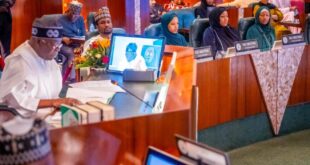
CBN Governor, Olayemi Cardoso, spoke on the matter during the Nigeria Domestic Investment Summit, themed Operationalising Nigeria’s First Policy, hosted by the Ministry of Industry, Trade and Investment on Monday in Abuja.
The bank’s comments come just before the Monetary Policy Committee is set to decide on the benchmark interest rate on Tuesday, a rate that significantly influences the country’s investment climate.
Represented by the Director of Risk Management, Blaise Ijebor, Cardoso acknowledged the burden of high interest rates on businesses and the productive sector. However, he stressed that the approach is crucial to address long-standing macroeconomic challenges.
He said, “High interest rates are painful. We all know that. We all recognise that, especially for the real sector. But interest rates are not just about affordability, they are also about credibility.”
Cardoso argued that the current policy direction was sending “a strong signal that Nigeria is serious about defending the value of its currency, restoring macroeconomic balance, and regaining investors’ confidence.”
He noted that upon assuming office, the central bank inherited an economy fraught with distortions, a disorganised forex market, and diminishing trust from investors.
He said, “Eighteen months ago, our financial markets were in disarray. The foreign exchange system was broken. There was policy opacity and severe investor apathy.
“Our immediate task as a Central Bank was to arrest the slide and restore discipline. And that meant bold reforms, not technical tweaks, starting with exchange rate unification, phasing out unsustainable interventions, and returning to a transparent market framework.”
He maintained that the bank’s tightening measures, although tough in the immediate term, have begun to yield dividends in the form of stronger investor interest, improved reserves, and a more predictable policy climate.
He added, “But while we defend stability with one hand, we are using the other hand to build inclusivity. We are improving access to finance, modernising payment infrastructure, streamlining regulation, and setting the stage for banks to better support businesses. That’s the spirit behind the recapitalisation programme.”
Cardoso also praised local investors for their resilience in the face of recurring economic instability and urged them to take full ownership of the recovery process.
He said, “You all stayed the course. You continued to bet on Nigeria. That kind of patriotism is not just admirable, it is the foundation on which any credible recovery must be built.
“Your insights, challenges, innovations, and practical suggestions are critical to shaping a financial system that works for, with, and on your behalf, not against you.”
Also speaking at the summit, the Executive Chairman of the Federal Inland Revenue Service, Zacch Adedeji, said the agency is transforming into a pro-business platform rather than a punitive one.
“When you talk about the Nigerian Revenue Service, it’s deliberate. We are not law enforcement agents. We are service providers. You are our bosses,” Adedeji declared.
He noted that under the current administration, over 60 fragmented taxes had been merged into a single-window system, aiming to simplify compliance for businesses.
“We are here to remove your burdens. This is not about taking powers from any agency. It is about simplifying processes so businesses can scale, export, and grow,” he said.
In his remarks, the National President of the Nigerian Association of Chambers of Commerce, Industry, Mines and Agriculture, Jani Ibrahim, emphasised the crucial role of local investors in driving Nigeria’s economic progress.
“Foreign investment is important, but let us never underestimate the power, resilience, and ingenuity of local investors, MSMEs, and industrialists who have stayed committed to the Nigerian project.
“As we pursue the $1tn economy by 2030, domestic investment must be at the heart of our national strategy. And I assure you, we will surpass that target,” he stated.
He also revealed plans for NACCIMA to host a Made-in-Nigeria expo later in the year, intended to spotlight homegrown industries and unlock new scaling opportunities.
The Permanent Secretary of the Ministry of Industry, Trade and Investment, Abba Rimi, described domestic investors as key players in building a sustainable national economy.
“Domestic investors are community builders, job creators, and drivers of local value chains,” Rimi said.
He reaffirmed the government’s commitment to supporting Nigerian businesses through policy collaboration and continued dialogue.
He added, “This summit is not just a dialogue platform. It is a place to showcase investment-ready opportunities, resolve challenges, and build solutions that reflect the realities of Nigerian entrepreneurs. We are listening. We are learning. And we are ready to act.”
African Telescope reports that the summit was convened at the directive of President Bola Tinubu and coordinated by Trade Minister Jumoke Oduwole. It is designed to formulate targeted strategies, policies, and reforms that will support the Renewed Hope Agenda, implement the Nigeria First Policy, and realise the vision of a $1 trillion economy by 2030.