 African Telescope Independent Journalism. African Perspectives
By Ogar Emmanuel
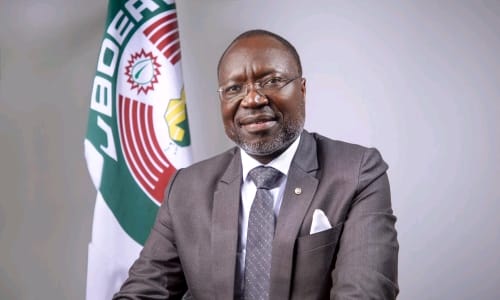
The Economic Community of West African States (ECOWAS) is targeting a 5 per cent regional economic growth in 2026, President of the ECOWAS Commission, Dr. Omar Alieu Touray, has said.
Touray disclosed this on Thursday in Abuja while briefing development partners, noting that the West African sub-region outperformed the African average in 2025, recording 4.6 per cent growth.
“Despite global economic slowdown and lingering uncertainty, Africa has shown resilience. Growth is recovering and inflation is declining,” Touray said.
“In 2025, West Africa outperformed the continent.
Growth stood at 4.6 per cent and is projected to rise to 5 per cent in 2026.”
Reforms, investment drive growth
The ECOWAS chief attributed the performance to structural reforms, increased investment in mining and energy, improved regional trade facilitation, and a rebound in services, transport and tourism.
“This robust performance is driven by reforms, rising investments and stronger regional trade,” he said.
“Inflation remains high, but we are seeing noticeable declines, helped by coordinated monetary policies and better food supply across member states.”
Touray added that fiscal deficits have narrowed, debt-to-GDP ratios declined modestly, and the region’s external position remains strong, supported by exports of oil, gold and bauxite.
Security still top priority
On security, Touray said peace and stability remain central to ECOWAS’ mandate, as parts of the region continue to face insecurity.
“In 2025, ECOWAS intensified preventive diplomacy, mediation and democratic support,” he said.
He confirmed progress against organised crime and terrorism, including the takeover of the West Africa Police Information System from Interpol after 12 years, though reduced cooperation with the AES bloc has complicated counter-terrorism efforts.
“While attacks declined slightly, fatalities increased due to the rising use of improvised explosive devices,” he noted.
Free movement, integration deepen
Touray disclosed that ECOWAS launched the second phase of the Free Movement and Migration Project, validated the ECOVISA online portal, and expanded biometric identity cards to seven member states, including Nigeria.
“Cross-border cooperation intensified, benefiting border communities, especially women,” he said.
Support for women, youth, trade
According to him, over 1,300 small-scale cross-border traders and 50 women-led SMEs benefited from capacity building, while rural women gained access to digital skills training.
He also highlighted the ECOWAS Trade and Investment Forum, expanded customs digitisation, regional road studies, renewable energy initiatives, and humanitarian support exceeding $8 million.
Zero tolerance for coups
Touray reaffirmed ECOWAS’ firm stance against unconstitutional changes of government, citing its swift response to an attempted coup in Benin Republic.
“ECOWAS sent a clear message: there is zero tolerance for coups in the region,” he said.
On Guinea-Bissau, he explained that the destruction of election results informed ECOWAS’ decision to back a short, inclusive transition focused on reforms and fresh elections.










