 African Telescope Independent Journalism. African Perspectives
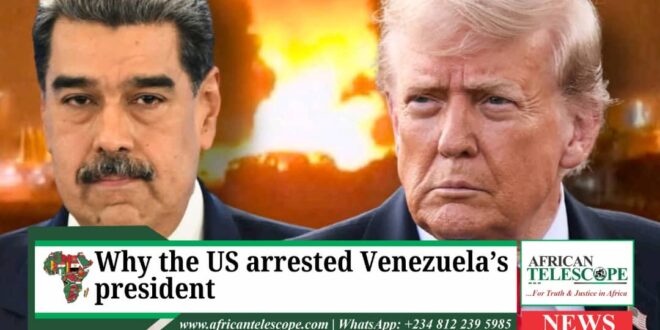
US President Donald Trump has confirmed that American forces have captured Venezuela’s leader, President Nicolas Maduro.
Trump in a statement on posted on his Truth social media handle on Saturday also stated carried out a large-scale military strike on Venezuela.
This followed an explosions rocked Venezuela’s capital, Caracas, in the early hours of Saturday.
The United States have been targeting Venezuela mainly because of a combination of political, security, and economic reasons that have built up over several years.
First, Washington accuses Venezuela’s President, Nicolas Maduro, of undermining democracy.
The US and many Western countries rejected his 2024 re-election, describing it as fraudulent.
The US position is that Maduro no longer has legitimate democratic authority, which has been used to justify pressure aimed at forcing him out of power.
Second, the US government alleges that Maduro leads or protects a major drug trafficking network.
American officials have repeatedly accused senior Venezuelan figures of collaborating with drug cartels and allowing cocaine shipments to pass through the country to North America and Europe.
Venezuela strongly denies these allegations, but they have formed a key basis for US sanctions and military actions.
Third, energy and economic interests play a role. Venezuela has the world’s largest proven oil reserves. The US argues that oil revenues are being used to entrench Maduro’s rule and fund illicit activities. By tightening sanctions, seizing oil shipments and applying military pressure, Washington aims to weaken the economic base of his government.
Fourth, regional security concerns are involved. The US says instability in Venezuela fuels illegal migration, organised crime and insecurity across Latin America and the Caribbean. The deployment of US naval assets was initially presented as an anti-drug and regional security operation, before escalating into direct military action.
Finally, broader geopolitical calculations matter. Venezuela maintains close ties with US rivals such as Russia, China and Iran. Washington sees Caracas as a hostile government in its sphere of influence and believes decisive action could curb the influence of these rivals in the region.
Venezuela and its allies, however, argue that the US action amounts to regime change driven by imperial interests, control of oil resources and punishment of a government that refuses to align with US policies.










