 African Telescope Independent Journalism. African Perspectives
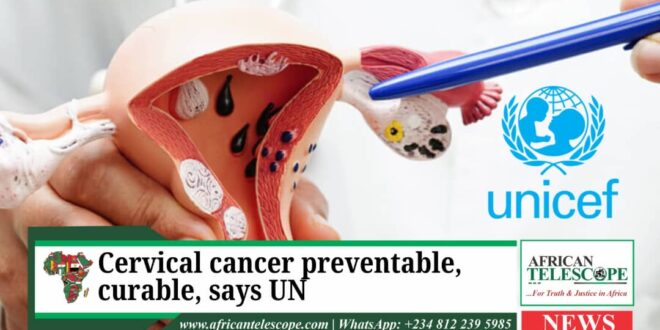
The United Nations has said cervical cancer is both preventable and curable if women have proper access to screening, vaccination and timely treatment.
The UN made this known in a statement on Friday as part of activities marking January as Cancer Awareness Month, noting that cervical cancer remains the fourth most common cancer among women globally.
Cervical cancer is a reproductive cancer that develops in a woman’s cervix and can spread to other parts of the body if not detected or treated early.
According to the World Health Organisation, about 660,000 women were diagnosed with cervical cancer worldwide in 2022, while an estimated 350,000 women died from the disease.
UNICEF also warned that cervical cancer claims the life of a woman every two minutes, describing the situation as a major public health concern, especially in low and middle-income countries.
Health experts say almost all cases of cervical cancer are linked to infection with the human papillomavirus, a very common virus transmitted through sexual contact.
While most HPV infections clear naturally, persistent infection with high-risk types can lead to abnormal cell growth and cancer.
The WHO stressed that cervical cancer is one of the most successfully treatable cancers when detected early and managed effectively.
It recommended HPV vaccination for girls aged 9 to 14 before they become sexually active, as well as regular cervical screening from age 30, or 25 for women living with HIV.
Despite these preventive measures, unequal access to vaccination, screening and treatment continues to drive higher rates of illness and death in regions such as sub-Saharan Africa, Central America and Southeast Asia.
In 2020, 194 countries adopted a global strategy to eliminate cervical cancer, with November 17 designated as World Cervical Cancer Elimination Day.
Under the strategy, WHO set three targets to be achieved by 2030: vaccinating 90 per cent of girls against HPV by age 15, screening 70 per cent of women by age 35 and again at 45, and ensuring 70 per cent of women diagnosed receive treatment.
WHO estimates that achieving these goals could prevent 74 million new cases of cervical cancer and avert about 62 million deaths by 2120.
Source: NAN










