 African Telescope Independent Journalism. African Perspectives
By Mobolaji Jaiyeola |
At least 80 children were reportedly killed on Saturday after a missile struck an all-girls elementary school in southern Iran, according to state media.
Iranian parents had just dropped their children off for classes when they rushed back to school gates as bombs reportedly began falling across the country during a joint attack by the United States and Israel.
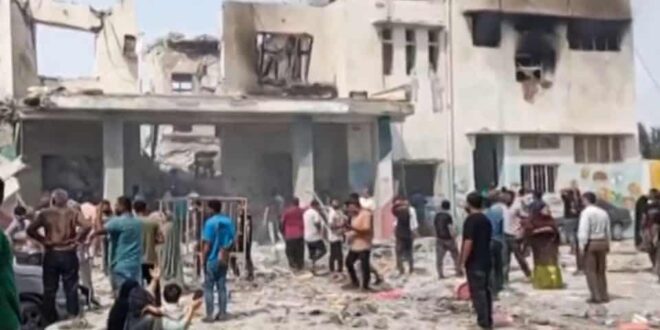
The strike reportedly hit Shajareh Tayyebeh all-girls school in Minab, southern Iran.
Iran’s state-controlled IRNA news agency said at least 80 children were killed, with dozens more unaccounted for.
Videos circulating on social media, said to show the immediate aftermath, captured smoke rising from burned-out walls and debris scattered across the road.
Hundreds of onlookers were seen gathered at the site, many visibly distressed, with screams heard in the background.
The Guardian said the report of the bombing, its death toll, and the video’s source could not immediately be independently verified.
Persian fact-checking service Factnameh said it cross-referenced the footage with other photographs and concluded the video was authentic.
Reuters also said it had verified the footage as being from the school.
The school was reported to be located next to a Revolutionary Guards barracks.
If confirmed, the strike would be the largest mass civilian casualty incident of the US-led attack so far.
Across Iran, residents described a mixture of fear, uncertainty, and guarded hope as the bombings continued.
Some Iranians said they felt relief that the long-anticipated strikes had begun, while others feared the attacks would lead to more civilian deaths.
In Tehran, residents sheltered in their homes as traffic gridlocked with parents rushing to retrieve children following school closures.
Many said they had spent weeks preparing for war by stockpiling water and basic supplies.
Amir, a 37-year-old bakery owner in Tehran, said he felt “relieved” that strikes appeared to hit government buildings but feared civilian casualties.
“My worry is that innocent people will be killed,” he said.
Amir said members of his family were injured during the regime’s recent crackdown on nationwide protests.
“We have endured so much grief,” he said. “Despite that, we don’t want to see the body bags on the streets due to US and Israeli strikes.”
The attacks came amid diplomatic negotiations between Iran and the United States.
Moein, who lost two friends during the protest crackdown, said Iranians opposed foreign intervention but felt trapped.
“When weapons come from the US, do they strike us more gently than when they come from the regime’s killing machines?” he asked.
He said residents had prepared for war but lacked access to bomb shelters.
The war was launched on Saturday morning, with former US President Donald Trump announcing the start of “major combat operations” against Iran.
Trump urged Iranians to rise up and “take over your government.”
The first wave of strikes reportedly hit near offices linked to Iran’s supreme leader Ali Khamenei.
Mehnaz, a 27-year-old resident of Tehran, said she heard loud explosions around 9am while having breakfast.
“It’s a strange feeling,” she said.
“Both fear and hope for the end of the regime.”










