 African Telescope Independent Journalism. African Perspectives
By African Telescope |
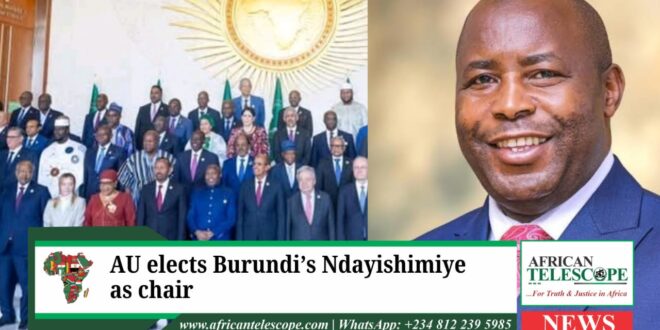
African Union has elected Burundi’s President, Évariste Ndayishimiye, as Chairperson of the Union for 2026.
The election took place on Friday during the Thirty-Ninth Ordinary Session of the Assembly of Heads of State and Government of the African Union, which opened at the AU headquarters in Addis Ababa, Ethiopia.
This was disclosed in a statement issued by the AU media unit on Saturday.
The two-day summit is being held under the theme “Assuring Sustainable Water Availability and Safe Sanitation Systems to Achieve the Goals of Agenda 2063” and features wide-ranging deliberations on peace, security, institutional reform and continental development priorities.
Addressing the Assembly, the Chairperson of the AU Commission, Mahmoud Ali Youssouf, described access to water as a collective good critical to Africa’s development and peace.
Youssouf said the summit was taking place amid mounting geopolitical turbulence, marked by persistent conflicts, institutional fragility and a resurgence of unconstitutional changes of government in parts of the continent.
He urged member states to accelerate political and economic integration under Agenda 2063, stressing that institutional reform and financial self-reliance had become imperative as external funding continues to decline.
The AU Commission chair called for stronger domestic resource mobilisation and faster implementation of flagship continental programmes, including industrialisation, agricultural transformation, energy development and infrastructure expansion.
Youssouf also noted rising expectations from Africa’s youth, women and civil society, insisting that the current decade of Agenda 2063 must deliver measurable and tangible results.
He expressed solidarity with populations affected by conflict in Sudan, the Sahel, eastern Democratic Republic of the Congo and Somalia, as well as with the Palestinian people, reaffirming respect for international and humanitarian law as fundamental to global peace.
Outgoing AU Chair and President of Angola, João Manuel Gonçalves Lourenço, formally opened the summit, describing access to water as a political, moral and strategic priority essential for Africa’s development, public health, food security and stability.
Reflecting on Angola’s tenure, Lourenço highlighted progress in advancing Agenda 2063, mobilising investment for infrastructure, strengthening continental integration through the African Continental Free Trade Area, and promoting reforms aimed at improving AU efficiency.
On peace and security, he stressed the need to silence the guns, citing ongoing conflicts in Sudan and the Democratic Republic of the Congo, as well as terrorism in the Sahel and Horn of Africa.
He reaffirmed the AU’s rejection of unconstitutional changes of government and warned against legitimising coups through subsequent elections.
Also speaking at the summit, Ethiopian Prime Minister, Abiy Ahmed, called on Africa to move from reacting to global events to actively shaping the global agenda, particularly as the AU approaches its 25th anniversary.
He emphasised unity, confidence and ownership of Africa’s narrative and technological future, pointing to Ethiopia’s establishment of an artificial intelligence institute and plans for an AI university.
United Nations Secretary-General, António Guterres, underscored the importance of strengthening the UN-AU strategic partnership, highlighting multilateral cooperation as vital for peace, security and sustainable development.
He reaffirmed support for Africa’s development goals, industrialisation, equitable access to financing and the need for reform of the UN Security Council to ensure stronger African representation.
Following the election of Ndayishimiye as Chair, the new Bureau of the Assembly for 2026 was announced, with Burundi as Chair, Ghana as First Vice Chair, Tanzania as Second Vice Chair, a Third Vice Chair from North Africa to be confirmed, and Angola as Rapporteur.
Deliberations at the summit are continuing, with sustained focus on water security and pressing peace and security challenges across the African continent.










