 African Telescope Independent Journalism. African Perspectives
Chibuzor Alli
The son of Hong Kong media tycoon Jimmy Lai has said his father’s 20-year prison sentence under China’s national security law amounts to “a death sentence”, as pressure mounts from the UK and US for his release on humanitarian grounds.
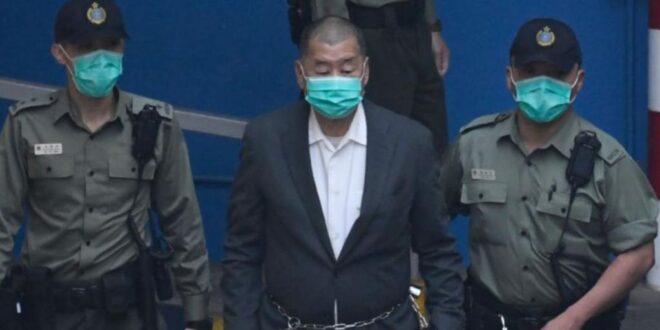
Lai, a 78-year-old British citizen and one of Beijing’s fiercest critics, was sentenced on Monday after being convicted last December of national security offences. It is the longest sentence handed down so far under Hong Kong’s controversial national security law (NSL). Lai has always denied the charges.
His son, Sebastien Lai, said the punishment was retribution for “defending the freedom of Hong Kong”.
Lai, the founder of the now-defunct pro-democracy newspaper Apple Daily, has spent the past five years in solitary confinement in a maximum-security prison. His son said the conditions and his father’s failing health made the sentence effectively terminal.
“Given his health, given that he has heart issues, given that he’s lost 10kg over the last year alone, that’s basically a death sentence,” he said.
Sebastien Lai said his father, as a British citizen, deserved far better.
“Surely a man who has given so much for liberty, for freedom deserves a bit of it himself,” he told BBC Radio 4’s Today programme.
UK Foreign Secretary Yvette Cooper said the government would “rapidly engage further” with Beijing over Lai’s case.
“I again call on the Hong Kong authorities to end this appalling ordeal and release him on humanitarian grounds, so that he may be reunited with his family,” she said on Monday.
She added: “We stand with the people of Hong Kong.”
In Washington, US Secretary of State Marco Rubio condemned the ruling as “an unjust and tragic conclusion to this case” and urged authorities to grant Lai “humanitarian parole”.
The sentence, he said, “shows the world that Beijing will go to extraordinary lengths to silence those who advocate fundamental freedoms in Hong Kong”.
Once celebrated by the pro-democracy movement and vilified by Beijing, Lai has long been a flashpoint between China and Western governments. Repeated calls from the UK, the US and others for his release have been rejected.
China imposed the NSL in 2020 after mass pro-democracy protests the previous year. The law criminalises a wide range of dissent, including acts deemed to involve secession, subversion, terrorism or collusion with foreign forces, and allows some cases to be transferred to mainland China.
A Hong Kong court ruled that Lai used Apple Daily as part of a campaign to lobby foreign governments to impose sanctions on Hong Kong and China. He was convicted of foreign collusion and publishing seditious material under the law.
Prime Minister Keir Starmer said last month that he raised Lai’s detention during talks in Beijing.
“Part of the rationale for engagement is to make sure that we can both seize the opportunities that are available – which is what we’ve done – but also have a mature discussion about issues that we disagree on,” Sir Keir said after meeting President Xi Jinping.
Former prime minister David Cameron also weighed in, calling Lai’s imprisonment “an affront to freedom of speech”.
“China must know that the world is watching,” he wrote on social media.
Sir Keir’s visit to China delivered closer economic ties, including visa-free travel for UK citizens for trips of up to 30 days and a cut in import taxes on UK whisky from 10% to 5%.
Sebastien Lai said his father’s release could be an easy diplomatic win for Beijing.
“If we talk about warming a relationship, well, I think for most people listening to this, isn’t putting a 78-year-old man on a plane and sending him back here a very easy way for Hong Kong and China to do that?”, he told the BBC.
China has defended the case, with its foreign ministry insisting the actions taken were “reasonable, legitimate and legal” and saying there is “no room for argument”.










